
 HCAOA members…if you haven’t already done so, send a message to your Senators that you support an amendment to the Veterans’ Health Empowerment, Access, Leadership, and Transparency for our Heroes (HEALTH) Act (S.1315).
0 Comments
 HCAOA urges all members to take action now by sending a message to your Senator regarding the Veterans’ Health Empowerment, Access, Leadership, and Transparency for our Heroes (HEALTH) Act (S.1315). Sponsored by U.S. Senator Jerry Moran (R-KS), U.S. Senator Kyrsten Sinema (I-AZ), and Rep. Mariannette Miller-Meeks (R-IA-1), this vital legislation aims to protect and expand veterans' access to care while safeguarding them to choose their own providers and require the VA to improve the quality of care veterans receive.
Great news for the home care and home health industries in Washington! The final state operating budget was recently released, and HCAOA’s budget proviso requests were all included. Private duty nursing and home health Medicaid rates both saw increases. See below for more details.
HCAOA Holds First All-Member National Legislative Call Last Week – Recording Now Available!3/13/2024 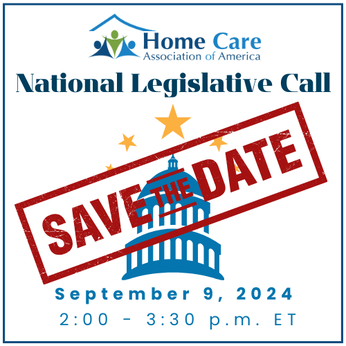 Last week, HCAOA held the first of two National Legislative Calls for all members. These updates are a free member benefit designed to provide the latest information about home care issues HCAOA advocates for at the national level in DC and also spotlight the issues state chapters are following. A recording is available for those who may have missed this call. Be sure to sign up now for the second call on September 9.
 Two significant and far-reaching bills affecting the home care industry have been filed by Senate and House majority leaders. As the first bills designated from each caucus, they are a high priority and are very likely to pass.
 HCAOA members are invited to register for Polsinelli's Home Care Industry Update on March 14 at 12:00 p.m. ET. HCAOA CEO Jason Lee will participate in a panel discussion with representatives from Polsinelli and The National Association for Home Care & Hospice (NAHC) for a comprehensive overview of the latest legislative and legal developments.
 The Illinois Department of Public Health has updated regulatory rules on Intermediate Care for the Developmentally Disabled Facilities Code, published on February 16, 2024, in the Illinois Register, p. 2546. The rules now require intermediate care facilities for the developmentally disabled, whether operated for profit or not, to refer a resident only to licensed home service agencies.
Yesterday, HCAOA met with the Office of Information and Regulatory Affairs within the White House’s Office of Management and Budget to discuss CMS’ proposed Medicaid Access Rule, also referred to as the 80/20 Rule. This rule, among many other things, would mandate that 80% of Medicaid reimbursement dollars pass through to caregiver wages, leaving only 20% of the reimbursement for all other costs incurred in providing services.
Senators Thom Tillis (R-North Caroline) and Maggie Hassan (D-New Hampshire) and Congressman Mike Carey (R-Ohio-15) and Congresswoman Judy Chu (D-California-28) introduced the Connecting Caregivers to Medicare Act of 2024 (S.3766). The bill would help inform Medicare beneficiaries and individuals applying for benefits under Medicare Part A or enrolling under Medicare Part B about the option to fill out a form to give Medicare permission to share their personal health information with a family caregiver through 1-800-MEDICARE. This authorization form helps family caregivers when they call 1-800-MEDICARE to assist their loved one or advocate on their behalf, saving family caregivers time and making it easier for them to interact with Medicare to support and assist their loved one.
 Last week, the U.S. Administration for Community Living (ACL) released the final rule to update the Older Americans Act (OAA) – the first significant change to the act in more than 35 years. The OAA supports a wide array of programs and services to help seniors live independently, including information and referral, congregate and home-delivered meals, health and wellness programs, in-home care, transportation, elder abuse prevention, caregiver support, and adult day care. The rule updates reflect the increased needs of a nearly-doubled senior population since the last rule change. It also solidifies flexibilities put in place during the COVID-19 pandemic that promoted aging in place, such as carry-out meal programs for seniors.
 Recently, Sen. Michael Bennet (D-Colorado) reintroduced the Credit for Caring Act (S.3702), a bipartisan bill that would establish a nonrefundable federal tax credit of up to $5,000, covering up to 30% of qualified expenses exceeding $2,000. These expenses cover vital aspects of caregiving, including home care aides, adult day care, home modifications, assistive technology, respite care, and transportation.
|
Archives
April 2024
Categories
All
Upcoming Events |
 RSS Feed
|
Phone: 202-519-2960 | 444 N. Capitol Street NW, Suite 428 | Washington, DC 20001
info@hcaoa.org | sitemap © 2024 Home Care Association of America. All Rights Reserved. | Privacy Policy | Refund Policy |
|